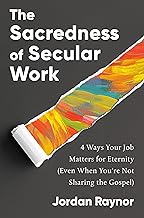
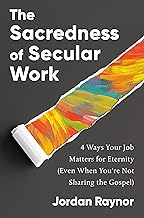
The Missing Dominion: Why the Noachic Bridge Critiques Jordan Raynor’s Theology of Work
Does secular work physically last into eternity? Explore a traditional critique of Jordan Raynor’s "un-abridged gospel" through the lens of the Noachic Covenant and the missing dominion mandate.
BOOK REVIEWTHEOLOGY, SOTERIOLOGYESCHATOLOGY
David M Turner
2/2/20266 min read
The Missing Dominion: A Noachic Critique of the "Un-Abridged" Gospel of Work
I. The "Abridged" Accusation: Raynor’s Challenge
For decades, the American pews have suffered under a quiet dualism. On Sunday, we are told we are "ambassadors for Christ," but on Monday morning, we feel like cogs in a secular machine. Jordan Raynor, in his influential book The Sacredness of Secular Work, identifies this as the "abridged gospel"—a truncated version of the good news that focuses exclusively on the salvation of individual souls for a disembodied afterlife.
Raynor’s "un-abridged gospel" is compelling. He argues that Christ is redeeming the entire created order and that our daily labor—from coding software to crafting furniture—is an instrumental part of "building the Kingdom of God." He grounds this in the "Creation Mandate" of Genesis 1, suggesting that our work is a direct continuation of the mission given to Adam: to take dominion and subdue the earth.
However, Raynor’s solution to the sacred-secular divide may inadvertently create a new problem. By collapsing the distinction between the "Common Kingdom" of Noah and the "Messianic Kingdom" of Christ, Raynor risks placing a redemptive burden on the worker that Scripture never intended. To see why, we must look at the massive theological bridge Raynor skips over: the Covenant with Noah.
II. The Noahic Bridge: The Mandate That Changed Everything
To understand the nature of work today, we cannot simply leap from the perfection of Eden to the professions of the 21st century. We must pass through the Flood. The Covenant with Noah (Genesis 9) is not merely a "renewal" of the Adamic mandate; it is a fundamental shift in the administration of the earth.
The Missing "Dominion"
In Genesis 1:28, God blesses Adam and Eve with a specific four-fold mandate:
Be fruitful and multiply.
Fill the earth.
Subdue it (kabash).
Have dominion (radah).
This was the "Royal Stewardship." Adam was a king-priest in a sanctuary-world, ruling over a creation that was in total harmony with him. But when we turn to Genesis 9:1-7, where God speaks to Noah after the Flood, the language undergoes a chilling shift. God repeats the command to "be fruitful and multiply and fill the earth," but the words dominion and subdue are conspicuously absent.
Instead of dominion, God says: "The fear and dread of you shall be upon every beast of the earth..." (Genesis 9:2). Why the change? In a fallen world, "dominion" (a benevolent, royal mastery) is no longer possible. The relationship between man and creation has moved from harmony to hostility. Adam was a gardener; Noah is a survivor.
The Shift to Preservation
The Noachic Covenant introduces what theologians call "Common Grace." Because human "dominion" turned into "violence" (hamas) that corrupted the earth (Genesis 6:11), God established a new administrative order. This order is not about "Redemption" (which comes through the Seed of the woman) but about Preservation.
God promises to hold back the chaos. He promises that "while the earth remains, seedtime and harvest, cold and heat, summer and winter, day and night, shall not cease" (Genesis 8:22). This is a covenant of restraint. God is not commissioning Noah to build the New Jerusalem; He is commissioning Noah to keep the world functioning so that the plan of salvation can unfold through the lineage of Shem.
III. Work as Human Government
The Noahic Covenant as the start of the "Dispensation of Human Government." In this era, the primary "secular" task given to humanity is not "Kingdom building" but the restraint of sin and the maintenance of order.
The "Sword" vs. The "Scepter"
In Genesis 9:6, God institutes capital punishment: "Whoever sheds the blood of man, by man shall his blood be shed, for God made man in his own image." This is the birth of civil law.
Raynor’s "un-abridged gospel" tends to view secular work through the lens of the Scepter (the Kingly rule of Adam). But the Noachic Covenant views work through the lens of the Sword and the Plow (the restraint of evil and the provision for needs). When a Christian works as an accountant, a lawyer, or a mechanic, they are participating in the "Noachic administration." They are helping to maintain the "Common Kingdom"—the shared social space where believers and unbelievers alike can survive until the Day of Judgment.
The Error of "Redemptive" Work
Raynor argues that secular work is "sacred" because it contributes to the redemption of the world. But, work is "sacred" because it is a Doxological Stewardship. You don't need to be "redeeming" your office to honor God. You honor God simply by being a faithful steward of the Noachic order. When you do your job well, you are loving your neighbor and reflecting God’s character as a Preserver. By labeling this as "Kingdom building," Raynor risks devaluing the "commonness" of the work God actually assigned us.
IV. The Fire of 2 Peter 3: The Great Discontinuity
A major pillar of Raynor’s argument is Continuity—the idea that our earthly work will physically survive into the New Earth. He often points to a "fuller gospel" that doesn't "burn up" the world but "purifies" it.
However, the Apostle Peter—using the Noachic Flood as his primary point of reference—paints a starkly different picture. In 2 Peter 3, he argues that just as the "world of that time" was deluged and perished, the current heavens and earth are "reserved for fire" (2 Peter 3:7).
Dissolution vs. Refinement
Raynor leans on the metaphor of a refiner’s fire. But Peter uses the word lyō, meaning "to dissolve" or "unloose."
"The elements will be dissolved with fire, and the earth and the works that are done on it will be exposed [or burned up]." (2 Peter 3:10)
This represents a Great Discontinuity. The "works" done on the earth (our buildings, our software, our empires) are part of the "Noachic stage" that will be struck once the play of history is over. This does not make the work meaningless; it makes the work temporal. Raynor’s view puts an immense burden on the worker to create "eternal" things. But the Noachic reality is that we are working in a tent, not a temple. We are stewards of a world that is passing away. Our hope is not in the work of our hands surviving the fire, but in the King who brings a radical New Creation "down out of heaven" (Rev 21:2).
V. Revelation 21: The Glory of the Nations
The "smoking gun" for Raynor’s "Continuity" model is Revelation 21:24-26: "The kings of the earth will bring their glory into it... they will bring into it the glory and the honor of the nations." Raynor suggests this "glory" consists of our literal cultural artifacts—architecture, music, and art—cleansed of sin.
1. Glory is People, Not Products
In the prophetic tradition (specifically Isaiah 60), the "glory of the nations" refers to the wealth and the redeemed people of the world coming to Zion to worship. It is a picture of the conversion of the nations, not the preservation of their gadgets. When the nations "bring their glory" to Christ, they are bringing themselves as trophies of His grace.
2. The Identity of the King
Raynor’s "un-abridged gospel" suggests that we are the ones building the Kingdom through our work. But the Dispensationalist notes that the New Jerusalem is not a human project. It is "prepared as a bride adorned for her husband" (Rev 21:2). It is a gift from God, not the "final draft" of human progress.
3. Reward vs. Result
The "glory" we carry into eternity is our faithfulness, not our fluids or folders. In 1 Corinthians 3, Paul notes that while our "work" may be burned up, the worker is saved and rewarded for their faithfulness. The "sacredness" of secular work is found in the character it forges and the service it provides, not in the physical longevity of the product.
VI. Conclusion: The Peace of the Noachic Steward
Jordan Raynor is right to hate the sacred-secular divide. He is right that God cares about our 9-to-5 lives. But his solution—turning every job into "Kingdom-building"—may actually be a form of "Work-Righteousness" applied to the cultural mandate.
The Noachic Covenant offers a "Fuller Gospel" that is more honest about the Fall. It tells us that we live in a world of "fear and dread" where the dominion Adam lost hasn't been restored yet. We are not "kings" of our cubicles; we are "stewards" of a world in labor pains.
By acknowledging the "Missing Dominion," we find a deeper peace. We don't have to "save the world" or "build the Kingdom" through our careers. We can simply do our work well, love the people in front of us, and maintain the order of the world until the King returns to take the dominion that we cannot. Our work is not the "raw material" of heaven; it is a "doxological sacrifice" offered on a temporary altar. And in the eyes of God, that is enough.
Suggested Reading: The Cosmic Christ and The Cosmic Pause by David M. Turner